
Spalding County Criminal Court Records
A criminal court record in Spalding County is the case file maintained by the court after a prosecutor files a criminal charge, an accusation, or an indictment. The file may begin with an arrest or warrant event, but the court record is broader. It tracks the case as it moves from filing to arraignment, motions, plea, trial setting, disposition, sentence, and later probation or revocation entries. For the charge list itself, including amended or dismissed counts, the arrest-to-charge path is treated more closely in Spalding County arrest records and court charges.
Felony prosecutions belong in Superior Court through the Griffin Judicial Circuit. The Clerk of State and Superior Court keeps the Superior Court criminal filings, and the District Attorney handles felony prosecution. State Court handles misdemeanors, misdemeanor traffic, DUI, reckless driving, speeding, battery, domestic violence, stalking, criminal trespass, shoplifting, theft by taking, and county ordinance criminal cases. The Solicitor General reviews those law enforcement cases and represents the State in State Court. Magistrate Court matters can include warrant issuance, preliminary criminal matters, deposit-account-fraud misdemeanors, and ordinance cases.
The official Spalding County Solicitor General page shows how misdemeanor cases are reviewed and prosecuted in State Court. That local role helps explain why a person may see an arrest event first, then a formal charge filed later by the prosecutor.
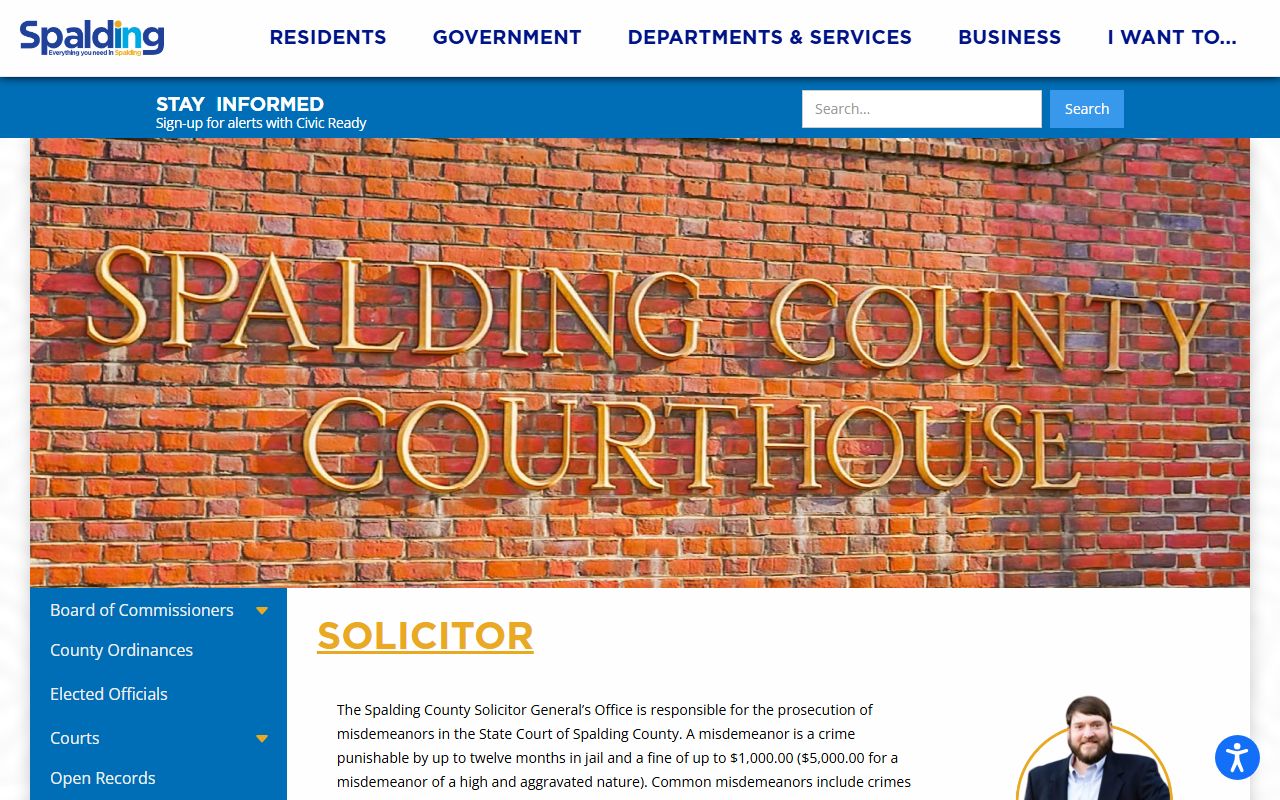
The Solicitor source is most useful for misdemeanor criminal records because it identifies the office that files and handles many State Court charges after law enforcement sends a case forward.
Search Spalding County Criminal Records
Spalding County links court users to Access Online Case Files, a Tyler-hosted Georgia court records search portal. Georgia Courts also describes statewide e-access through provider sites and notes that account access may be required. That means the online route is official, but it is not always a one-click public index. If the portal is unavailable, if the case is older, or if a certified copy is needed, contact the Clerk of State and Superior Court criminal division or the specific court that handled the case.
- Identify the court first. Felonies generally point to Superior Court, while misdemeanors and DUI or traffic-related crimes usually point to State Court.
- Try the county Access Online Case Files link and search with the exact defendant name, case number, or filing date if known.
- Read the docket entries in order. Look for accusation, indictment, arraignment, motion, plea, disposition, and sentence entries.
- For copies or missing records, call the Clerk criminal division at (770) 467-4745 or visit the courthouse counter.
- For non-case public records or custodian-directed requests, use the Spalding County JustFOIA public portal.
The Georgia Courts e-access page is a statewide explanation of provider-based case access. It is helpful when the county portal redirects, asks for an account, or separates the search interface from the court office that keeps certified records.

The State Court material matters because misdemeanor criminal case records often include appointed-counsel, plea, diversion, court-date, and sentence activity that does not appear in a jail-only search.
Spalding County Criminal Case Flow
Criminal court records make more sense when read as a sequence. One arrest can lead to several counts, but each count may end in a different way. A felony record may show Magistrate Court warrant activity, then Superior Court indictment or accusation entries. A misdemeanor record may show State Court accusation, arraignment, plea, trial setting, diversion activity, or sentence. State Court also warns that mailed notices control when there is a conflict with online information.
Case flow: Charges Filed › Arraignment › Pretrial and Motions › Plea or Trial › Disposition › Sentencing.
| Stage | What the Criminal Court Record May Show |
|---|---|
| Charges Filed | Accusation, indictment, warrant origin, transferred charge, or prosecutor filing. |
| Arraignment | Formal court appearance where the charge is addressed and a plea may be entered. |
| Pretrial and Motions | Requests for court orders, continuances, discovery disputes, bond issues, or evidentiary rulings. |
| Plea or Trial | Guilty, not guilty, nolo plea, bench trial, jury trial setting, verdict, or trial reset. |
| Disposition | Outcome for each count, such as guilty, dismissed, not guilty, nolle prosequi, or diversion result. |
| Sentencing | Jail, probation, fine, restitution, community service, treatment terms, or revocation conditions. |
Spalding County Criminal Record Fields
The research did not capture a live Tyler sample record, so exact provider labels should not be guessed. Local court practice and the Spalding County record inventory do support a clear field inventory. A criminal case file commonly identifies the court, division or judge, parties, filing date, status, docket entries, financial obligations, hearing dates, and documents filed in the case. Some fields may be redacted for personal identifiers, juvenile information, mental-health details, protected addresses, or sealed materials.
| Field | What It Shows |
|---|---|
| Case Number | Provider-assigned case identifier. The research did not verify a public Spalding format. |
| Court | Superior Court, State Court, Magistrate Court, Juvenile Court, or another court tied to the case. |
| Defendant | Person accused in the criminal case, usually styled as State of Georgia versus the defendant. |
| Charges | Counts filed by accusation, indictment, citation, or other charging paper. |
| Docket Entries | Chronological filings, hearings, motions, orders, pleas, notices, and calendar activity. |
| Disposition | Outcome of each charge or case, such as guilty, dismissed, acquitted, or nolle prosequi. |
| Sentence | Jail, probation, fine, restitution, treatment, or other terms ordered after conviction. |
The Georgia Public Defender Council defender search helps separate court record access from defense representation. For Spalding County criminal matters, the research identifies the Griffin Judicial Circuit public defender and a separate State Court appointed-counsel path.
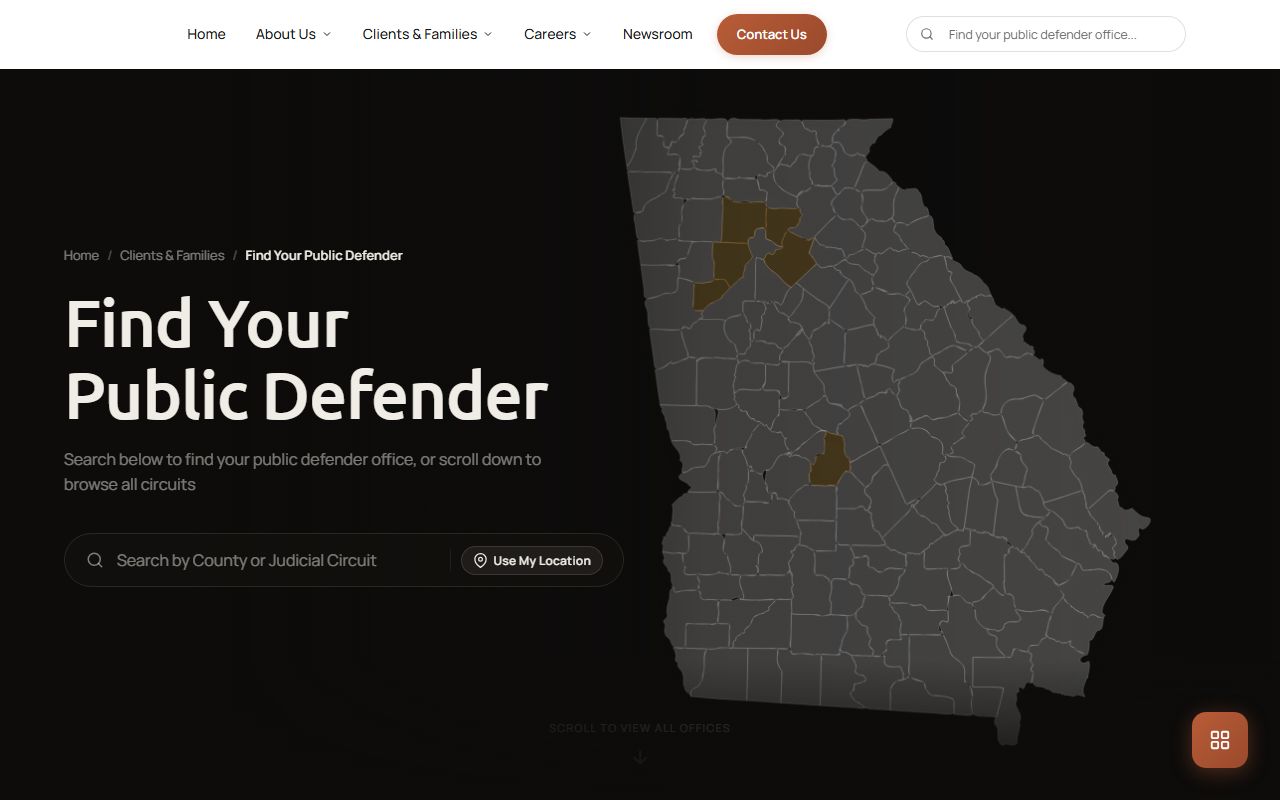
Defense office information can help a defendant understand representation channels, but official criminal court records still come from the clerk, the court, or the provider portal.
Criminal Charges and Convictions
A charge is not a conviction. Spalding County criminal court records can show counts that were filed but later amended, reduced, dismissed, or not prosecuted. They can also show a conviction by plea or verdict. Reading only the first charge line can give the wrong impression, so the disposition and sentence fields matter. A single case may have mixed results, with one count dismissed and another count ending in a plea.
| Point | Charge | Conviction |
|---|---|---|
| Meaning | An accusation that a crime occurred. | A guilty plea, guilty verdict, or other finding that supports sentence. |
| Where It Appears | Charging document, docket, citation, indictment, or accusation. | Disposition, judgment, sentence, probation, or revocation entries. |
| Record Risk | May remain visible even if later dismissed unless restricted or sealed. | May appear in the court file and may be reported to state systems. |
Restricted Spalding Criminal Records
Georgia law favors public access to government records, but criminal court access is not unlimited. The Georgia Open Records Act includes inspection, copying, fee, and exemption rules, while court orders and statutes can restrict particular records. Juvenile records, sealed indictments, mental-health materials, personal identifiers, protected victim information, and some active investigative records may be withheld or redacted. Juvenile Court files do not operate like ordinary adult criminal dockets.
| Record Status | Public Effect | Practical Route |
|---|---|---|
| Sealed | Removed from ordinary public access by law or court order. | Ask the clerk or court what order controls access. |
| Record Restriction | Limits criminal history dissemination for non-criminal-justice purposes. | Review the GBI process and contact the prosecutor or arresting agency. |
| Expungement Language | Older term often used by the public, while Georgia commonly uses record restriction. | Do not assume every court docket entry disappears after GBI restriction. |
The GBI criminal history record restriction page explains O.C.G.A. 35-3-37 and the different paths for arrests before and after July 1, 2013.
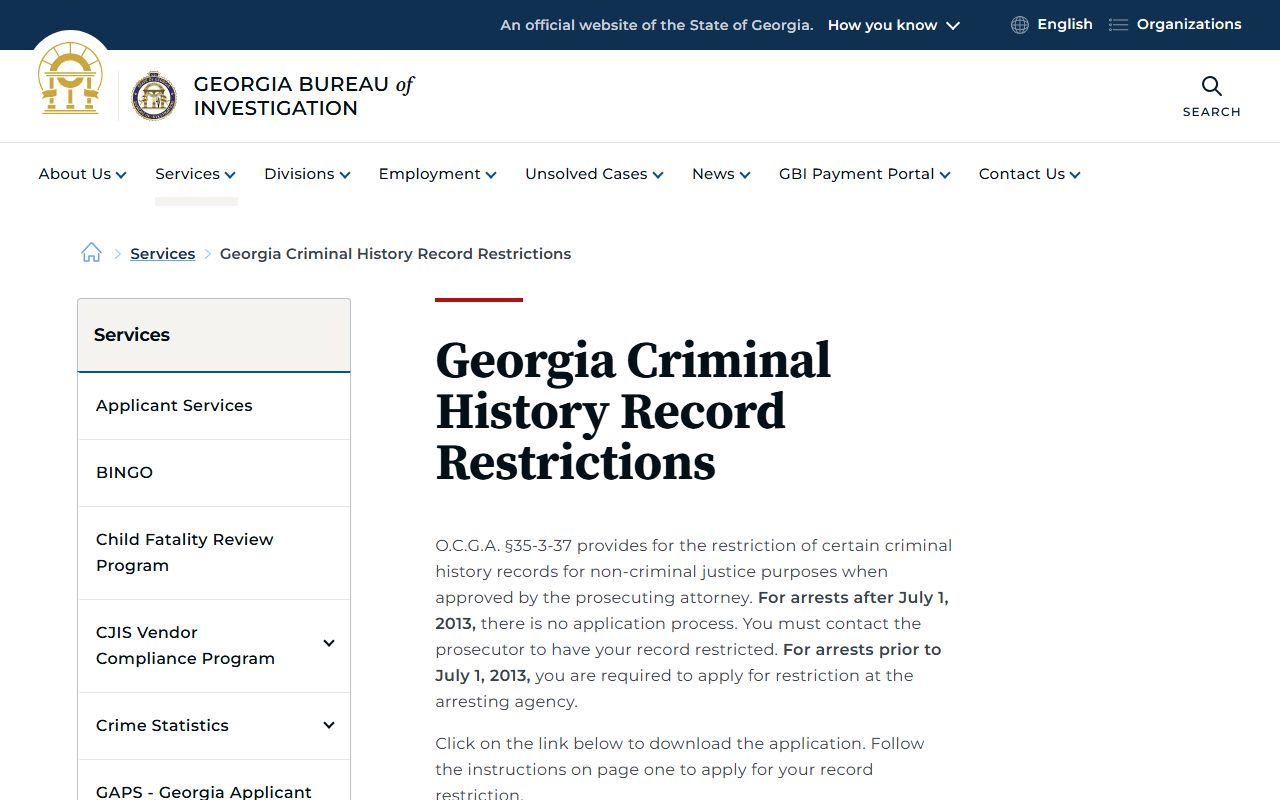
GBI restriction affects criminal history dissemination, while clerk case-file sealing may require separate court action or a separate order.
Key access laws: O.C.G.A. 50-18-70 and 50-18-71 state Georgia's public-records policy and request procedures, while O.C.G.A. 50-18-72 lists exemptions.
Note: Certified copies, sealed-file questions, and older criminal court records should be checked with the Clerk criminal division, not a third-party search result.